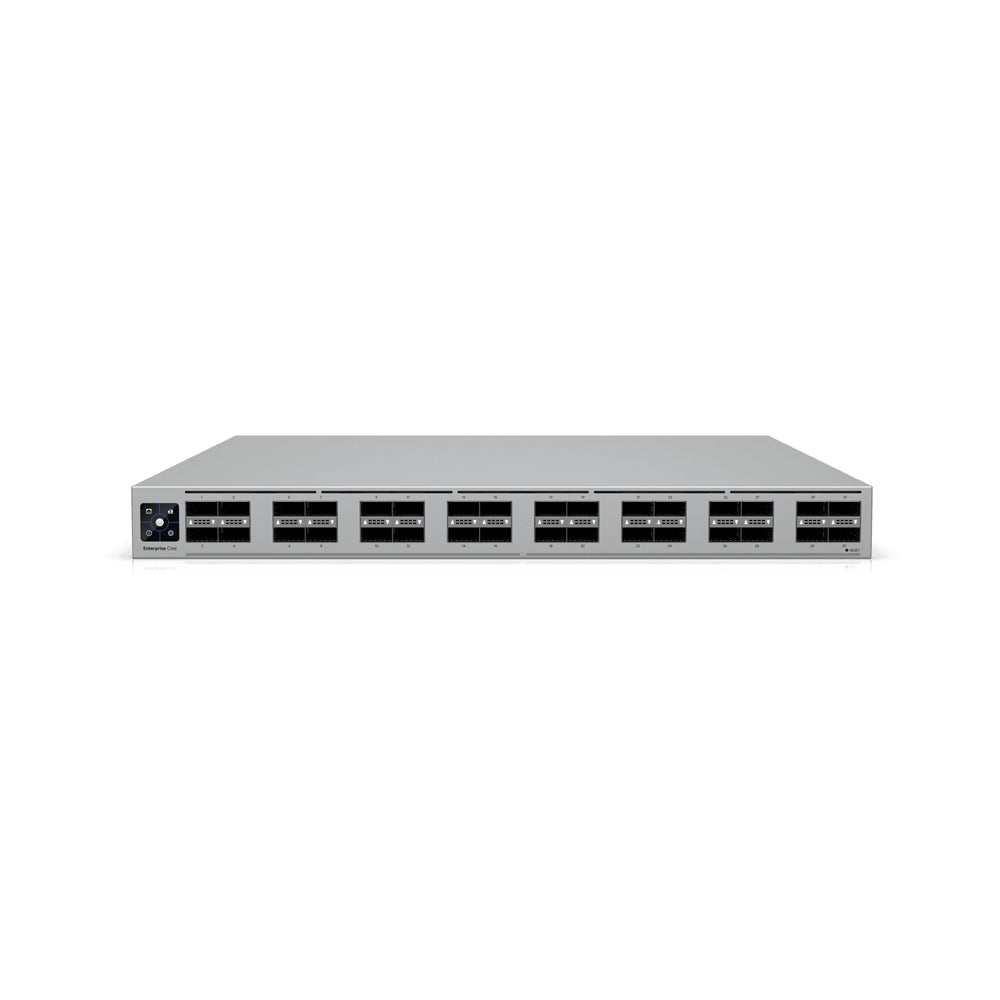


Ubiquiti UniFi Enterprise Switch Core 32-Port 100G Layer 3 | ECS-CORE
£5,311.24 inc VAT
ECS-CORE
Availability:
Couldn't load pickup availability
The Ubiquiti UniFi ECS-Core is a high-density 32-port 100G Layer 3 core switch with 3.2 Tbps non-blocking throughput and MC-LAG.
Key Features
- 32 x 100G QSFP28 ports, with 40G compatibility
- 3.2 Tbps non-blocking throughput
- 6.4 Tbps switching capacity
- Multi-chassis link aggregation (MC-LAG)
- Layer 3 routing and VLAN support
- 2 x hot-swappable PSUs and 5 x hot-swappable fans
- 1U rack-mounted core design with Etherlighting
- Standard Warranty : 2 Years
Downloads
Datasheet
Unprecedented Performance and High-Density Connectivity
Engineered for immense data demands, the ECS-Core features thirty-two (32) 100G QSFP28 ports. This delivers a staggering 3.2 Tbps total non-blocking throughput and a massive 6.4 Tbps switching capacity. This raw power ensures that high-traffic enterprise environments can operate flawlessly and free from bottlenecks, whilst a forwarding rate of 2.8 Bpps handles intensive packet volumes with ease.
Robust High Availability and Fault Tolerance
Built to eliminate single points of failure, the switch relies on Multi-Chassis Link Aggregation (MC-LAG) to ensure seamless redundancy and system design stability. The hardware is further fortified by two (2) hot-swappable 550W AC/DC power supply modules and five (5) hot-swappable fan units. This allows network administrators to replace essential components without interrupting critical traffic or causing costly downtime.
Advanced Layer 3 Routing Capabilities
Moving beyond standard switching, the ECS-Core comes fully equipped with a suite of Layer 3 features to optimise network efficiency. It fully supports inter-VLAN routing and static routing for local networks, alongside an integrated DHCP server and DHCP relay functions. This built-in intelligence allows the switch to manage complex campus topologies, streamline traffic routing, and significantly reduce the processing load on primary gateways.