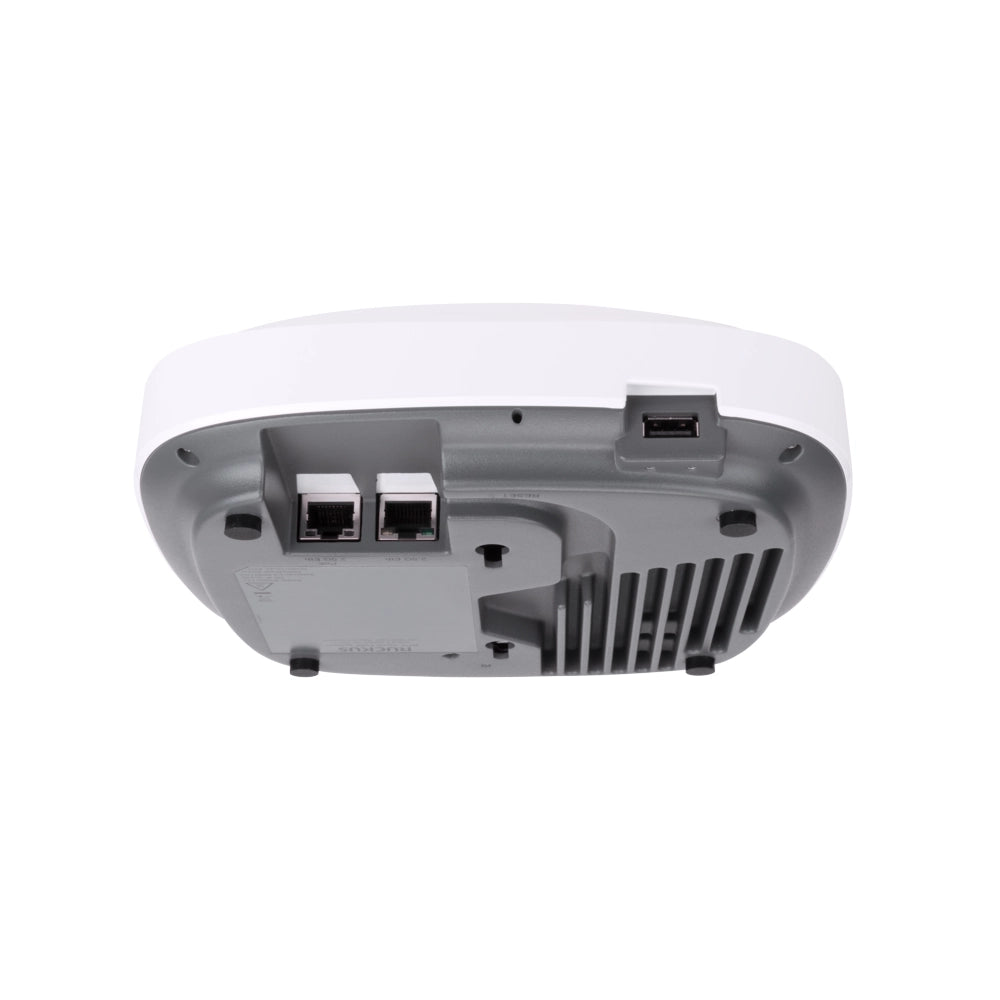


RUCKUS R575 Wi-Fi 7 Indoor Access Point | 901-R575-WW00
£732.60 inc VAT
901-R575-WW00
Availability:
Couldn't load pickup availability
The RUCKUS R575 is a high-performance Wi-Fi 7 2x2:2 indoor access point with dual 2.5 gigabit ethernet ports
Key features
- Tri-band Wi-Fi 7 with 2.4GHz, 5GHz and 6GHz support
- Dual 2.5 Gigabit Ethernet Ports
- Full performance at 802.3at
- BeamFlex+® adaptive antenna technology for improved efficiency and reliability
- Integrated IoT radio with BLE and Zigbee
- Wi-Fi 7 features including 320 MHz, 4K QAM modulation, Multi-Link Operations (MLO), and Quality of Service (QoS) improvements
- Designed for environments such as classrooms, MDUs, retail, and hospitality
Options
Cloud Management Licenses
Downloads
Datasheet
About this product
The Ruckus R575 is a high-performance enterprise-grade wireless access point designed to deliver next-generation connectivity in demanding indoor environments. Built on the latest Wi-Fi 7 (802.11be) standard, it provides significantly higher speeds, improved efficiency, and enhanced capacity for modern networks.
The R575 is a tri-radio access point (2x2:2) that supports simultaneous operation across multiple frequency bands, enabling better performance and reduced interference. It is engineered to handle high client density, making it ideal for environments such as hotels, offices, and smart buildings.
One of its standout capabilities is integrated IoT support, with dual IoT radios that allow seamless connection to devices like smart locks, sensors, and building automation systems.
Additionally, the device features multi-gigabit Power over Ethernet (PoE) ports, allowing it to power connected devices while maintaining high-speed data throughput. This simplifies deployment and reduces infrastructure complexity.
The Ruckus R575 represents a future-ready wireless solution, combining Wi-Fi 7 performance with IoT integration and enterprise-grade reliability. It is well-suited for organizations looking to upgrade their network infrastructure to support increasing device density and next-generation applications.